This blog is devoted to my John Welsford designed 15' Navigator yawl Ellie. I built her in my garage over a period of 18 months and launched her in 2011. She sports a sliding gunter main, roller furled jib and sprit-boomed mizzen. Her construction is glued-lapstrake over permanent bulkheads and stringers. This blog is a record of her construction and her voyages here in the Puget Sound area and (hopefully) a useful resource for fellow Welsford boat builders.

Sunday, November 7, 2010

Seats

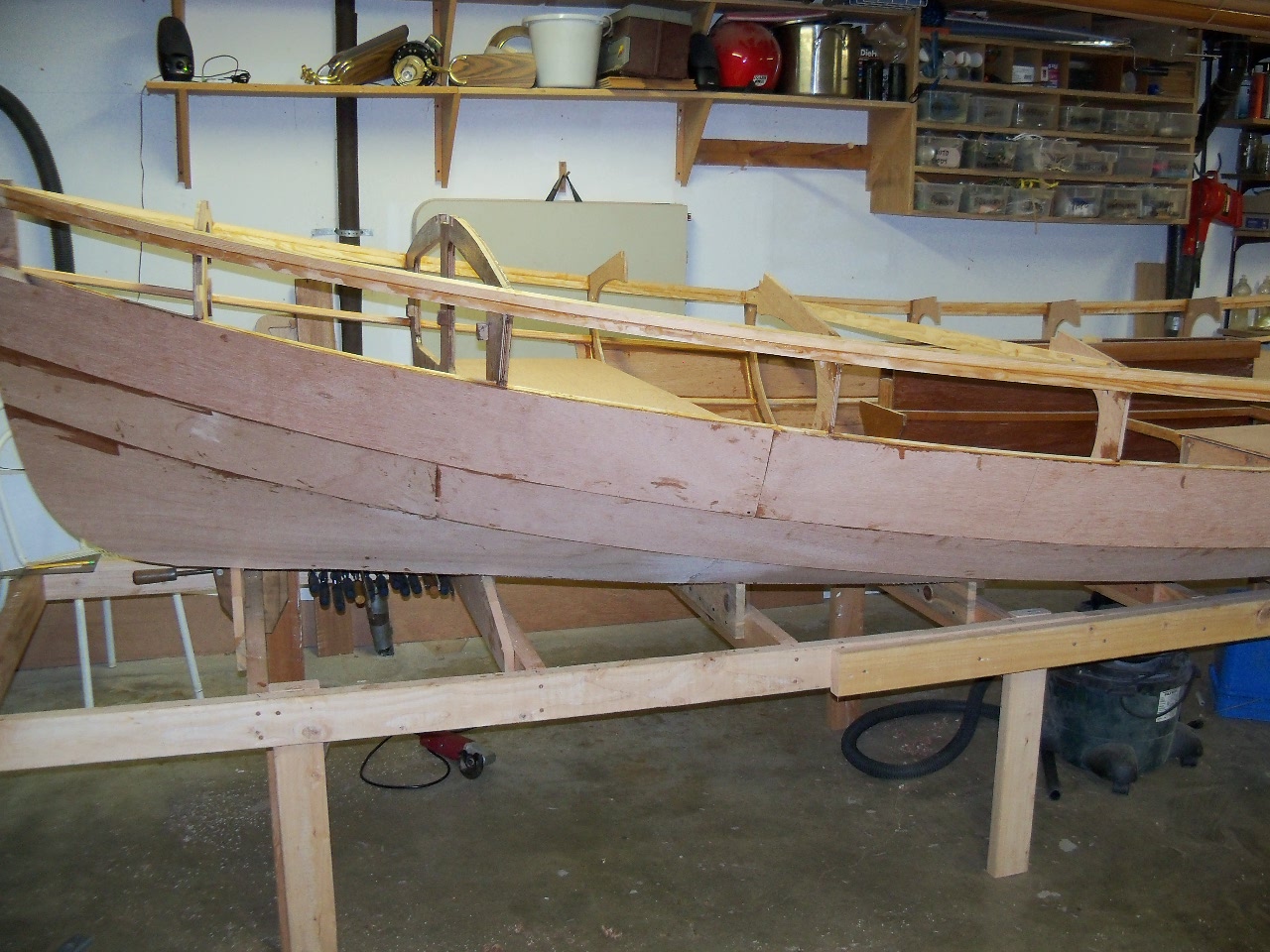
This weekend I worked on the seats.

Saturday I cut out and glued on all the seat side supports.


I also epoxy coated the inside of the seats/flotation compartments. No need to paint inside there.  Inspection and repairs are easier without paint getting in the way.

I also added a doubler underneath the port side seat. This is to reinforce where the boomkin mounts.


Sunday I glued in the seat tops.


The seat tops will eventually be covered with laid decking.

Wednesday, October 27, 2010

A little more work on the transom

Tonight I cut two more holes in the transom. A 1" drain hole, and a square hole for the boomkin.
That makes a grand total of 17 perforations through my transom. Six for the Duckworks motor mount, eight holes for the gudgeons, and three more for the tiller, boomkin and drain!  I hope the boat will still float despite all these holes!


Another challenge was how to trim all the planks flush with the transom. I thought about using a saw but was afraid of scratching the surface of the transom and chipping the planks. Then I thought I'd carefully whittle away at them with a sharp chisel. That would have taken forever.  I ended up using the Gain Machine


I set the Gain Machine so that the router bit was flush with the bottom of the base, like this:


Then, holding the base firmly against the transom, I used the Gain Machine to route the protruding planks flush with the transom.


The planks were perfectly flush a few minutes later.

Monday, October 25, 2010

Planking Complete!

We passed another major milestone this weekend - installation of the final plank - the sheer strake.
WoooHooo!


I decided to minimize the number of splices in this strake, because I am hoping it will look good enough to varnish. Since the Navigator is a 15' boat, I was just barely able to make the sheer strakes using one scarf joint in the middle. I figure one splice looks better than two.


I tried to do the best job I could with the scarf joints.  They look nice and clean but I won't know for sure until after they're faired and a coat of epoxy is applied. If it doesn't look good, I can always paint it or apply a vaneer.

But for now, time for a beer!

Tuesday, October 12, 2010

Planking away

Work has slowed a bit as we move into the rainy season here in the Pacific Northwest. Not only are the days getting shorter, colder and wetter, but I'm back to working overtime. *sigh*

Nevertheless, I'm glad to say that I am making some progress.

I've got most of the third row of planking on.


I've fitted the anchor well floor, the front seat, and started fitting the rear side seats. It's a good idea to cut these to size before installing the third row of planking. It's much easier to fit them in place over sized and scribe the outer hull position using a batten then to try and fit them later.


I have learned two valuable lessons this time around:

Lesson #1. Carefully inspect your plywood, no matter how good it's supposed to be. After installing part of my starboard plank, I noticed that something looked odd at one of the edges. Closer inspection revealed this:

.
Yikes! About a half inch of the edge of this sheet of plywood didn't get bonded properly. I'm using Aquatek BS-6566 marine plywood and I've built two boats using this stuff, and this is the first time I've run across a flaw like this.  I had to trim a half inch from the forward edge of one of my planks, which was already installed, to get rid of the bad edge.  I'm inspecting every piece from now on.

Lesson#2: When installing the planks, it's easy to clamp them along the top edge, but the bottom edge has to be fastened with screws, which are removed after the epoxy cures.  This leaves a line of ugly screw holes that has to be plugged and sanded. I started doing it this way but then I found a better way. Now I use my PowerShot staple & nail gun loaded with 1/2" nails.


This stapler has just enough power to drive these tiny little nails most of the way through a 1/4" sheet of plywood and into the underlying stringer.  To install the plank, I goop the stringers up with "peanut butter", clamp the plank in place along the top, then press firmly along the bottom and drive in a nail every few inches or so.


 The little nails are easily pulled later on with a pair of pliers, leaving just a little pinhole.  The only downside is that the stapler has a tendency to jam but it still beats using screws by a long shot IMHO.

Thursday, September 23, 2010

The Gain Machine


Before the next set of panels can be installed, there is some prep work to do. First, I had to mark where the bottom of the next panel will go so that I could cut the bevel in the lower panel. The panels overlap by 20mm which is the same width as the stringers. I made this simple jig with a pointer that rides along the top of the stringer and it holds a pencil 20mm away that draws the line on the lower panel.


The bevel has to go from this line the stringer above it.


I cut this bevel by aligning the two stringers and the plane by sight. Plane off some material and frequently check the progress.


Keep planing away material until the bevel reaches the line and it looks like this:


Making the remaining planks is similar to the way we made the garboard plank. First we measure the greatest width between the stringers and add about 50mm. Measure the desired length and add about 50mm. Cut a rectangular piece of plywood to that size. Clamp it to the boat. Trace the upper edges of both stringers onto the panel. Remove the panel.  Offset the lower curve by an additional 20mm so that the lower edge of the panel will align with the lower edge of the bevel.  Cut the panel to the profile. Fair the lower edge of the panel nice and smooth.  Epoxy the panel to the boat.

Cutting Gains

At the bow, the overlap between the two panels blend together with a tapered half-lap joint called a "gain". Gains can be cut many different ways. Often they are cut by hand using a saw followed by a chisel and finished off with a rabbet plane. I decided to cut the gains using a router, and I cut them in the panels before installing them on the boat. I didn't have much confidence in my ability to cut them by hand and I knew a router would be much faster and more accurate.

To use a router to cut the gains, I first had to come up with a jig. This is the jig, which I call "The Gain Machine".


The jig is made from two scraps of wood. The lower piece is made from 3/4" (20mm) stock and it has one pointed end cut at 45 degree angles, which I'll refer to as "the pointer".  The pointer rides along the edge of the panel to control the width of the gain.


The other piece is made of a scrap of 1/4" (6mm) plywood. The base for the router is attached to one end.  It has two slotted holes for screws and washers that attach it to the lower piece and allow the position of the pointer to be adjusted. The router is a trim router that I got from Harbor Freight Tools on sale for $20.


After assembling the two pieces, put a 3/4" (20mm) diameter straight router bit into the router. If you don't have a 3/4" bit, a smaller bit could be used but you would need to cut the gain in multiple passes. Adjust the pointer so the distance from the tip of the pointer to the far side of the bit is equal to the desired width of the gain.  In my case, the bit and gain are both 3/4" so the pointer just contacts the bit.

Set the depth of the bit so that the bottom of the bit is raised up by an amount equal to the thickness of the plywood panel (1/4" or 6mm in my case).


Now the jig is ready to cut gains.  Here is a video of the Gain Machine in action.
I don't see how cutting gains could be any quicker or easier than this!


Wednesday, September 15, 2010

Chapter 9: A tale of 2 planks

It was the best of planks, it was the worst of planks...

Sorry Charles.

The garboard plank on the Navigator is in many ways the easiest plank, and also the hardest to install. The aft half of the plank is quite flat. It is spliced together with nice friendly butt blocks - no scarfing is necessary. The plank is quite uniform in width. The entire lower edge of the plank is attached to the lower panel using the ever popular stitch-and-glue technique.

The forward half of the plank is a another story. It makes a near 90 degree twist while curving around the bow and increasing in width, culminating with an attachment to a contoured stem with a rolling bevel.

Let's start with the easy part.


Here is a section of the garboard plank from the transom through bulkhead 7. To make the plank, first we measure the greatest width between the bottom panel and the stringer and add about 50mm. Measure the length and add about 50mm. Cut a rectangular piece of plywood to that size. Clamp it to the boat. Trace the profile of the lower plank and stringer onto the panel. Cut the panel to the profile. Epoxy the panel to the boat. The joint between the lower panel and the plank gets stitch-and-glued, which means it is temporarily stitched to the lower panel with wire ties or bailing wire, dabs of epoxy are applied between the stitches. When the epoxy dabs cure, the stitches are removed, a fillet of epoxy/wood flour is applied over the joint, which is then covered with fiberglass tape and epoxy. There are two splices in the panel. Both splices are hidden under the seats, so there is no need to bother with scarfing the plywood joints. Simple "butt blocks" are glued over the top of the joint, held in place with temporary screws until the epoxy sets.


At the bow, the panel has to twist from near horizontal to vertical


It's hard to believe that plywood can actually do this, but it can.

The drill starts out much the same as before. Cut out an oversized panel and clamp it to the boat, slowly and carefully bending it into position so it can be traced to actual size and then be installed.

So first we clamp it in place at the aft end, making sure we overlap the lower panel, stringer, and the aft panel.


Then we work our way forward, applying more clamps and carefully and evenly apply pressure to the panel.


At this point I noticed that the panel was riding quite hard on the front, lower edge of the stem. I forgot to take a photo, but you can see what I'm talking about in this diagram. I had to remove the panel and plane off some additional material in this area until the panel fit properly.


Keep working your way forward. Avoid using clamps between the panel and the stringer. Quite a bit of force is required to bend the panel. The stringers will deform under that much force. I mostly used spreader clamps between the building jig and the panel to press it into place. Once the panel was in place, I added clamps to the stringers to pull the panel in the final fraction of an inch.


Another shot of the spreader clamps.


Finally the panel is in position.  Now trace around the lower panel, the stem, and the stringer onto the garboard panel.


Remove the panel and cut it to the traced profile.


Re-install the panel and re-clamp it to its final position. Stitch the garboard panel to the lower panel. Bailing wire or copper wire stitches work better than plastic ties in this area.

Glue the panel in place and repeat for the other side.


All I have left to do is finish the stitch and glue fillets and tape, and add the butt straps.

Tuesday, September 7, 2010

Chapter 8: Stringers

Yesterday I finished installing the stringers. Well, sorta finished. There are actually two more stringers to install that form the inner edge of the side decks, but they don't get installed until after the planking and seat tops are installed. It seems like they could be installed now. But now that I have shop space, I figured I'd try to actually start building things in the proper order for a change.

Anyhow, installing the (let's call them Outer Stringers) was rather uneventful. I bought several clear douglas fir boards from Lowes for a fraction of the price that the lumber yards wanted. They were nice clear boards, straight grained without a single knot or split. I proceeded to rip them into 3/4" (20mm) square strips (for the gunwale stringers) and 20mm x 15mm strips for the remaining stringers. I then scarfed them and epoxied them together with epoxy/silica mix to form 20 foot long stringers.

I had three concerns about the stringers, after reading other builders' blogs.
  1. Occasionally a stringer will split or break when attempting to bend it near the bow.
  2. Often it is very difficult to twist the stringer near the bow to fit up with the stem.
  3. The gunwale stringer, which is 40mm x 20mm, can be particularly difficult to bend, and may even require steaming.
Maybe I just got lucky, especially considering I was using cheap doug fir from Lowes, but I had no problems at all. 

I just jumped right in and torqued and twisted the stringers into place at the stem, fully expecting them to break, but they didn't.

For the gunwale stringers, I took the advice of other builders and made the stringer from two seperate 20mm x 20mm stringers. Again, they went right in without a hitch.

Spooky.

So I guess tomorrow I'll start planking.