This blog is devoted to my John Welsford designed 15' Navigator yawl Ellie. I built her in my garage over a period of 18 months and launched her in 2011. She sports a sliding gunter main, roller furled jib and sprit-boomed mizzen. Her construction is glued-lapstrake over permanent bulkheads and stringers. This blog is a record of her construction and her voyages here in the Puget Sound area and (hopefully) a useful resource for fellow Welsford boat builders.

Monday, June 20, 2016

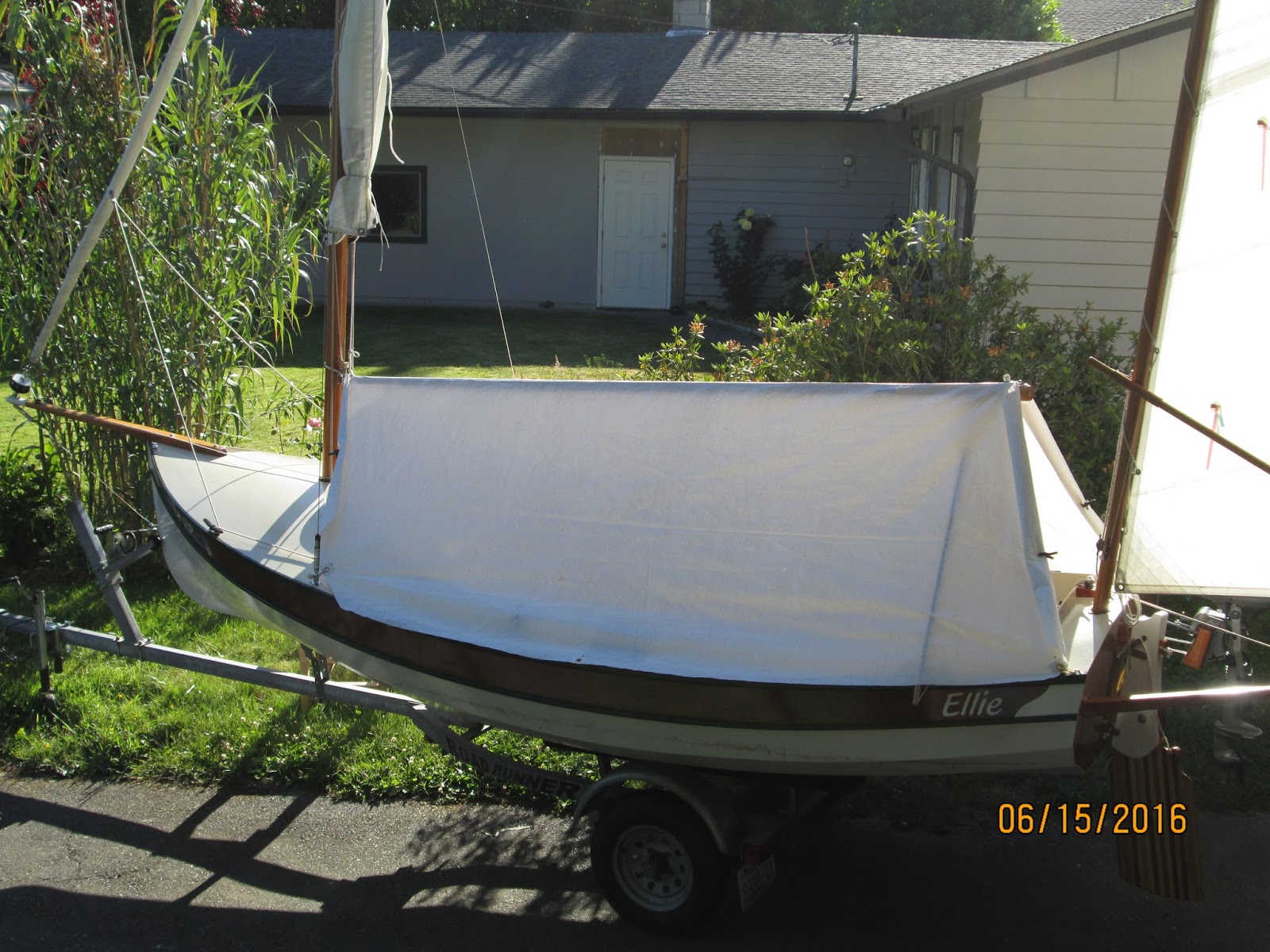
New and Improved boat tent - version 2

Boom tents are a common way to provide overnight shelter on an open sailboat. They can also provide shade at anchor on a hot summer day.  Here is how to make a simple and serviceable boom tent from an inexpensive polytarp, some plastic grommets and a little bit of duct tape.  It only takes a few hours to make, and guess what?  No sewing is required!


This tent is inexpensive and easy to construct.  It fits and functions well, it's quick to set up, and it's bright inside.


This tent is made from heavy duty white polytarp.   I recommend 12 mil thickness and go with white because it'll be brighter inside.  Have you seen those 10x20 foot temporary carports?  If you buy a replacement tarp for one of those it's the perfect size for this project.  Do not cut the polytarp with scissors or it'll fray at the edges!  Instead, use a soldering iron or hot knife along with a metal straight edge on a glass table top.  This will cut and melt the edges or essentially "cauterize" them.  This will prevent the tarp from fraying and save you a lot of time since no hemming is required.


Ideally the main sail should be stored outside the tent, not inside where you're sleeping.  The last thing you want, after sailing in rainy weather, is a wet sail dripping on you

I lash my mainsail to the gaff and raise the whole affair up the mast prior to setting up the tent.  After the tent is set up, I lower the gaff/mainsail combo back down so it rests on the boom.


The boom is supported with a boom crutch.  This holds the boom in place securely.  Snugging up the mainsheet and boom vang lock the boom in place. The ends of my boom crutch simply attach to the stern cleats with a loop of rope.


The tent is secured with bungee cords.  The same type of bungee cords they use on those portable carports.


After the boom tent is set up, I lower the gaff (which still has the mainsail lashed to it) down so it lies atop the boom, securing it in place with a bungee cord from the end of the gaff to the mizzen mast.

When not in use, I store the boom tent under the port seat.  I added quarter-turn hatches to the front of bulkhead 5 to provide a new storage area for the rolled-up tent and boom crutch.


The tent can also serve as a sun shield on hot summer days by flipping one side over the boom (folding the tent in half along the boom).  My Navigator sleeps one or two in comfort using my sleeping platform.

Is there room for improvement?  Of course. Fabric may be a better choice of material.  Then fancy windows, doors and mosquito netting could be added.  But overall I am quite pleased with the results.  This boom tent started out as a temporary solution.  As of this writing I've been using it for over 8 years.

You can download plans for the boom tent but you'll need to modify the measurements to fit your Navigator.




Wednesday, September 16, 2015

Tuesday, July 28, 2015

My dinghy cruising packing list

The key to organization is simple.  Just remember to PEEP.
 
Have a Place for Everything, and Everything in its Place

I always bring the same items and store every item in the same place for every trip.  A little organization goes a long way when you need to find something.  I try to bring only what I need, and I try to use items for multiple purposes whenever possible.  I only bring extras of items that are crucial.

Because it's unsafe, I cannot tolerate having things out where I have to walk on or around them.  I store everything in the lockers, under the thwarts and the side decks. Once everything is packed away, it looks like I'm not bringing anything at all, even when my son and I go on a week long cruise.  That's not easy to do in an open boat unless you are well organized.

Here is the packing list that I use.  As you can see, it lists each place on the boat and the items that are always stored there.  I use soft-sided cooler bags for food, drinks and cooking gear.  Four of them fit nicely on the front thwart.  I use backpacks for clothing, stored in the dry locker.   I use roll-top drybags for foul weather gear, stored under the aft thwart where I can quickly get to it.   I use a watertight box (a plastic ammo can) that is always within arm's reach for important frequently used items. These various containers are all marked with an asterisk and list their contents.

Most of this stuff stays on the boat permanently.  Usually all I have to pack for a trip is food and clothing, but I always go through this entire checklist before every trip to make sure nothing is missing or needs replacement.  I also update this checklist whenever anything changes.
 
You can download and customize this list for your own use by clicking here 


Sailing with Andrew's Navigator Wren

Sailing Ellie alongside my friend Andrew's beautiful Navigator Wren at the Port Townsend Pocket Yacht Palooza Crooza around Marrowstone Island, Washington was a real treat.
 

Andrew did a magnificent job building Wren. Her beautifully varnished seat tops and laminated tiller are especially beautiful.  I love her colors, and envy the batten arrangement in her mainsail, which allows the main to be dropped without removing the battens, unlike mine.  Comparing boats was a learning experience for us both, as we pondered  each other's ideas.  There are more photos of Wren here.

The Palooza and followup cruise were both fantastic.  We had every kind of weather, which made the trip quite interesting.  It was great meeting John Welsford again, albeit briefly, as John was quite busy tending to his Scamp Camp.

For more photos of the Pocket Yacht Palooza and Cruise, click this link.

Can't wait to do this again next year!

Tuesday, November 18, 2014

What happens when Stitch-and-Glue boats get old?

I came across this excellent article entitled "What happens when Stitch-and-Glue boats get old", posted on John Harris's blog "The Life of Boats".

John illustrates how epoxy-coated plywood boats age, and provides info on how to maintain and repair them.  It's an excellent article with very valuable info.

Here is the link to Part 1, and Part 2.

Friday, September 19, 2014

Port Townsend Wooden Boat Festival 2014

The Port Townsend Wooden Boat Festival was fantastic.  My wife and I had a terrific time seeing all our old friends again and meeting so many new ones this year.  Here is a short video compilation that I made with just a few of the many sights I was able to capture when I was able to sneak away from displaying Ellie.

Sunday, July 27, 2014

Sucia Small Boat Rendezvous 2014 Day 2

Saturday morning, after sleeping in a bit late, I fired up the Kelly Kettle while Tim did some writing.  Our Kelly Kettle, by the way, was a big hit.  Just about everyone who saw it was impressed with the speed it could boil water.  Several said they were going to get one for themselves.
There was no reason to hurry because we weren't going anywhere.  This is what the perigee-syzygy  does to shallow Fossil Bay.
 
A -2.8 tide does provide an excellent opportunity to see parts of the island normally hidden from view.  Like Sucia's treacherous reefs for example.
"Boaters should use caution when in the waters around this park. The word "sucia" is Spanish, meaning foul or dirty in a nautical sense. It refers to the numerous rocks and reefs which surround the island. These rocks and reefs have grounded and sunk numerous boats since European explorers first named the island in the 1790s. Boaters should check their charts frequently and pay particular attention to Clements Reef on the north shore of Sucia, as well as the entrances to Ewing Cove, Fox Cove, and Shallow Bay. There is a long reef which extends to the west of Little Sucia Island. Reefs also extend outward from Ev Henry Point, North and South Finger islands, and the Cluster Islands".
A couple years earlier I discovered what remained of one unfortunate boater's yacht, claimed by the reef at the entrance to Fox Cove.  This morning's low tide would be a great opportunity to see if the shipwreck was still there.
As I was about to set out for some shipwreck and fossil exploration, James McMullen appeared, looking for someone interested in going for a hike.  I told him about my plans and he agreed to join me.

We found the rusted, barnacle encrusted remains of the engine block and the boat's windlass right where I remember seeing them years before.  They were straddled one on either side of the reef that obviously sank the boat.  We looked for evidence of exactly where the boat hit the reef but saw no obvious scratches or anything in the reef, but James found some other bits of metal nearby.

From there, we went on to explore the fossils on the southern cliffs of the point.  Every year they look a bit different as the cliffside slowly erodes away, replacing last year's fossils with newly exposed ones.  Fossilized clams are by far the most common.  We didn't see anything else this year, but James discovered an unusually large one.

Later that afternoon, when the tide came in, Tim and I finally had an opportunity to explore Little Sucia Island.  This is a completely undeveloped little island just outside of Fox Cove.  It is surrounded by reefs and swift currents.  There is only one small patch of beach suitable to land a boat. The little bay on the North side looks inviting, but it's a boulder field just below the surface. We anchored at the patch of beach and walked around the island.  The entire shoreline is covered with rocks and there are no trails, no campsites, and no indication that anyone has ever visited the island.  Quite nice, actually!
We returned to our campsite at Fossil Bay.  Tim went for another hike out to Ev Henry point.  As he came around a corner, he startled two bald eagles which took flight only a few feet from him. He said he could hear the wind whistling through their feathers and it scared the crap out of him!  Tim also came across a pile of white feathers, apparently the remains of a seagull eaten by something.  The park ranger we talked to later said it was probably a hawk.

Later that afternoon was Wine and Cheese night, a visit from my fishing buddy Ray, followed by an evening around the campfire with drinks and music.

Good times.